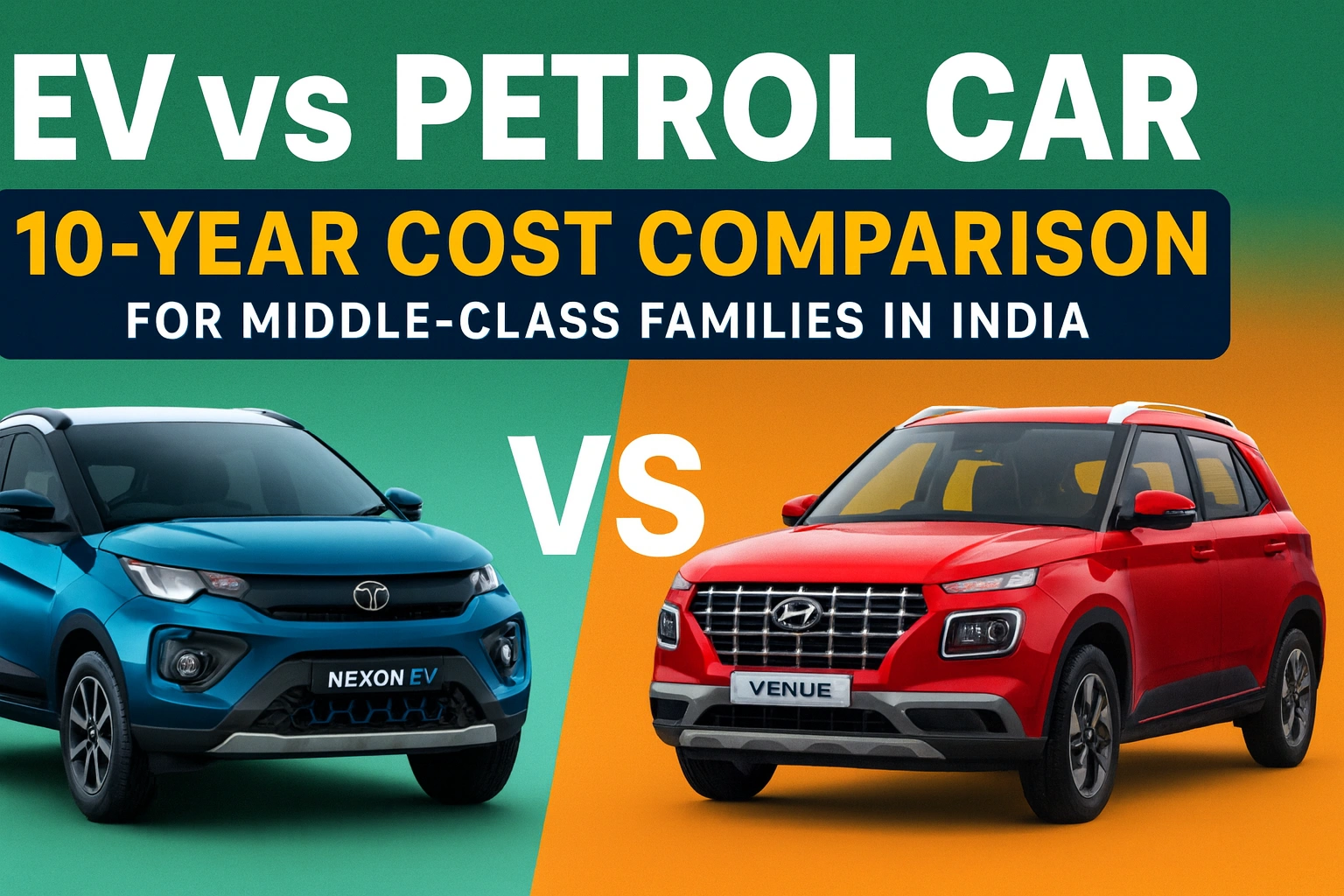
Electric Vehicles (EVs) are often marketed as the future of mobility, while petrol cars remain the trusted choice of Indian middle-class families. With rising fuel prices, government subsidies, and increasing EV models, many buyers are asking: “If I keep a car for 10 years, will an EV actually save me money compared to petrol?”
Let’s break it down with real calculations, using Indian road conditions, fuel costs, and ownership expenses.
🚘 Purchase Price Difference
The first difference families notice is on-road cost:
- Tata Nexon EV (2025, MAX variant): ~₹18 lakh
- Hyundai Venue Petrol (Top Variant): ~₹13 lakh
👉 Right at purchase, the EV is ₹5 lakh costlier.
⛽ Running Costs Over 10 Years (1,00,000 km)
Petrol Car (Venue):
- Mileage: ~14 kmpl
- Petrol price: ₹100/litre
- Fuel used in 1,00,000 km = 7,142 litres
- Fuel cost = ₹7.14 lakh
EV Car (Nexon EV):
- Energy efficiency: ~7 km/unit
- Electricity cost: ₹7/unit
- Units used in 1,00,000 km = 14,285 units
- Charging cost = ₹1 lakh approx
👉 Fuel Savings with EV = ₹6.14 lakh over 10 years
🔧 Maintenance Costs
- Petrol Car:
- Regular servicing (oil changes, filters, clutch, etc.)
- Total in 10 years = ₹1.5–2 lakh
- EV Car:
- Fewer moving parts, no oil changes.
- Total in 10 years = ₹60,000–80,000
👉 EV saves another ~₹1–1.2 lakh in maintenance
🔋 Battery Replacement Risk (EV Only)
EV batteries degrade after 7–8 years. Most retain 80–85% capacity by year 8, but if a replacement is needed:
- Tata Nexon EV Battery Cost: ₹5–6 lakh
This is the biggest risk factor for EV buyers. If you avoid replacement, EV is cheaper. If you replace, EV becomes costly.
🚗 Resale Value After 10 Years
- Petrol Car (Venue): Resale ~25–30% → ₹3–3.5 lakh
- EV Car (Nexon EV): Uncertain resale (battery condition matters). Likely ~₹3–4 lakh if battery is healthy.
📊 Real 10-Year Cost Calculation
| Expense | Petrol Car (Hyundai Venue) | EV Car (Tata Nexon EV) |
|---|---|---|
| On-road Price | ₹13 lakh | ₹18 lakh |
| Fuel/Charging (1L km) | ₹7.14 lakh | ₹1 lakh |
| Maintenance | ₹1.8 lakh | ₹0.8 lakh |
| Battery Replacement | ❌ | ₹5.5 lakh (possible after 8 yrs) |
| Resale Value | -₹3.2 lakh | -₹3.5 lakh |
| Total (10 Years) | ₹18.74 lakh | ₹21.8 lakh (with replacement) / ₹16.3 lakh (without replacement) |
🧾 Analysis
- If No Battery Replacement → EV is cheaper by ~₹2.4 lakh.
- If Battery Replacement Happens → EV is costlier by ~₹3 lakh.
- EV savings depend entirely on battery life and how much you drive.
👨👩👧 Which Families Should Buy EV vs Petrol?
EV is better for:
- Families driving 15,000+ km/year (high usage).
- City families with home charging access.
- Buyers planning to keep car 7–8 years max, then resell.
Petrol is better for:
- Families with low annual usage (<8,000 km/year).
- People in small towns/villages with poor charging infra.
- Buyers who want lower upfront price and no battery risk.
✅ Conclusion
For middle-class families in India, the 10-year cost battle between EVs and petrol cars is very close.
- EVs win if you drive a lot, have charging at home, and avoid battery replacement.
- Petrol cars win if your usage is low, or if you plan to keep the car beyond 10 years.
👉 The safest strategy? If you’re a high-mileage urban family, go EV. If not, stick to petrol (or consider a hybrid for balance).


