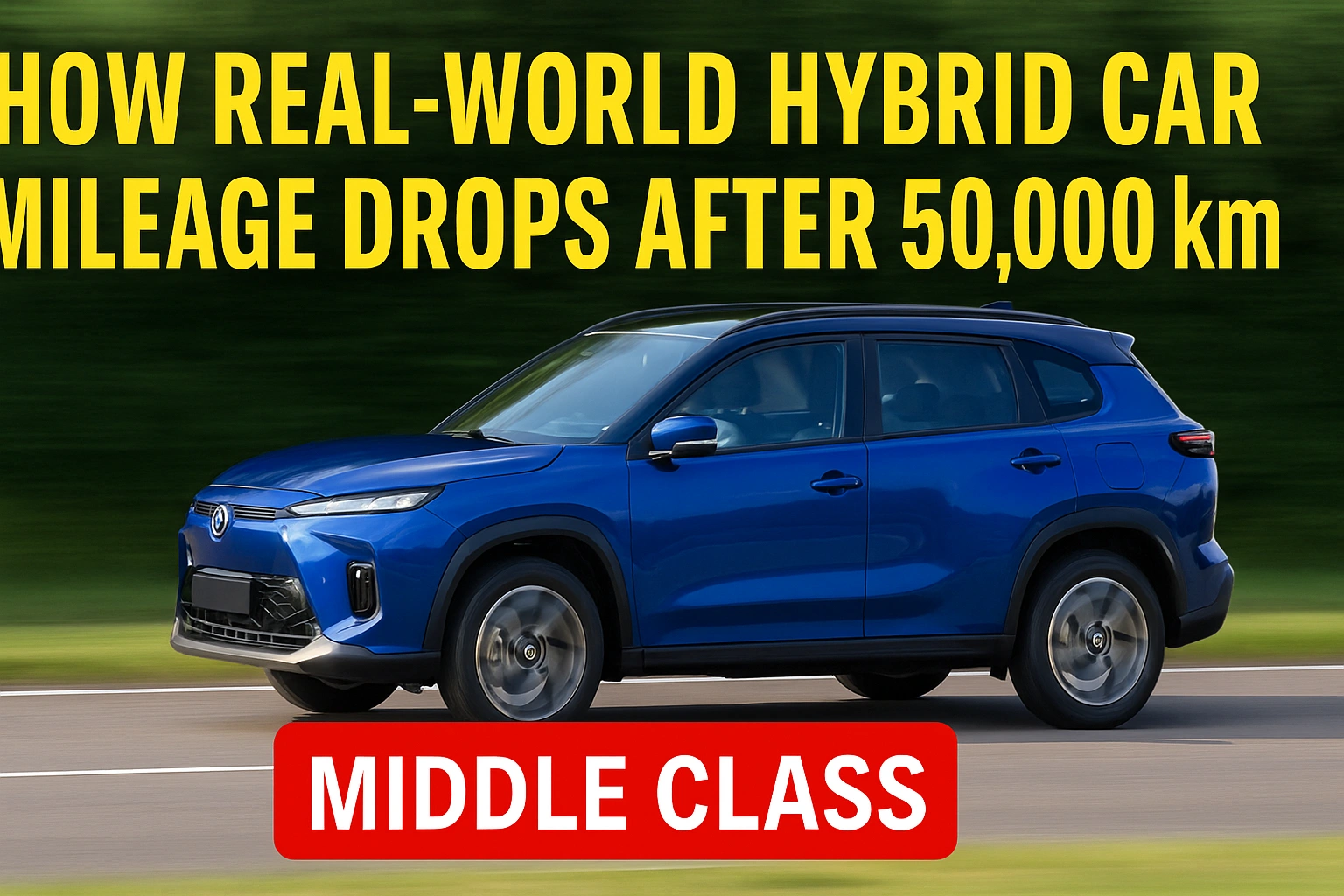
Hybrid cars are slowly becoming the middle-class dream machine in India. Families are drawn to them for one main reason — fuel efficiency. Brochures often promise an eye-popping 25–27 kmpl, especially for strong-hybrid models like the Toyota Hyryder, Maruti Grand Vitara, or Honda City e:HEV.
But here’s the truth: just like smartphones lose battery life with time, hybrid cars also lose fuel efficiency after years of real-world driving. Let’s explore why this happens, what families should expect after 50,000 km, and whether the savings are still worth it.
Why Mileage Drops in Hybrid Cars Over Time
- Battery Degradation
- Hybrid cars rely heavily on their lithium-ion batteries. Over time, just like any mobile battery, performance drops.
- After 3–5 years, battery efficiency can fall by 10–15% depending on climate and usage.
- Engine Load Increases
- As the hybrid battery weakens, the petrol engine kicks in more often → higher fuel consumption.
- Driving Conditions
- Brochure numbers are tested under controlled conditions.
- In Indian reality: bumper-to-bumper traffic, bad roads, heavy AC usage → actual mileage is lower.
- Climate Impact
- In hot cities like Delhi, Nagpur, Chennai, hybrid batteries heat up → efficiency drops faster.
- In cooler climates (Shimla, Bangalore), hybrids last longer.
Case Study: Hybrid Mileage After 50,000 km
1. Toyota Urban Cruiser Hyryder Strong Hybrid
- Claimed Mileage: 27.9 kmpl
- Owner Reports (After 50,000 km): 18–20 kmpl (city), 21–22 kmpl (highway)
- Drop %: ~25–30% compared to brochure
2. Maruti Suzuki Grand Vitara Strong Hybrid
- Claimed Mileage: 27.9 kmpl
- Owner Reports (After 50,000 km): 19–21 kmpl
- Drop %: ~20–25%
3. Honda City e:HEV Hybrid
- Claimed Mileage: 26.5 kmpl
- Owner Reports (After 50,000 km): 17–19 kmpl in cities, 20–21 kmpl on highways
- Drop %: ~25%
📌 Observation: Even after 50,000 km, hybrids deliver better mileage than pure petrol cars (which average 12–15 kmpl in city).
Real Cost Calculations: Hybrid vs Petrol (5 Years, 50,000 km)
Let’s assume fuel cost at ₹100 per litre.
🚗 Case A: Hybrid Car (e.g., Grand Vitara Strong Hybrid)
- Mileage after drop (average): 20 kmpl
- Total fuel used: 50,000 ÷ 20 = 2,500 litres
- Fuel cost: ₹2,50,000
🚗 Case B: Petrol Car (similar SUV, e.g., Hyundai Creta Petrol)
- Mileage: 14 kmpl
- Total fuel used: 50,000 ÷ 14 ≈ 3,571 litres
- Fuel cost: ₹3,57,100
💰 Savings in 5 years = ₹3,57,100 – ₹2,50,000 = ₹1,07,000
EMI Impact: Does Hybrid Justify the Higher Price?
- A petrol SUV (e.g., Creta) top variant: ~₹17 lakh on-road
- A hybrid SUV (e.g., Grand Vitara Hybrid) top variant: ~₹20 lakh on-road
- Price Difference: ₹3 lakh
If taken on EMI:
- Loan amount ₹3 lakh, 9% interest, 5 years = ~₹6,200/month extra
Over 5 years, that’s ~₹3.7 lakh extra cost.
But fuel savings in 5 years = ₹1.07 lakh.
👉 Net difference: Hybrid is still more expensive purely on fuel saving.
So Why Do Families Still Buy Hybrids?
- Peace of Mind in Long Run → Better resale value than petrol-only cars.
- Eco-Friendly Image → Many middle-class families like the idea of lower emissions.
- Daily Running Comfort → Hybrids feel smoother in traffic (engine shuts off at signals, EV-like drive).
- Future-Ready → With fuel prices rising, hybrids give some protection against inflation.
Tips to Maintain Hybrid Mileage for Longer
- Maintain Tyre Pressure → Under-inflated tyres reduce mileage by 5–7%.
- Avoid Aggressive Driving → Sudden acceleration drains battery + petrol.
- Regular Servicing → Clean air filters, battery checks.
- Use Eco Mode → Maximize battery usage in city traffic.
Conclusion
Hybrid cars don’t always deliver brochure mileage forever. After 50,000 km, expect a 20–30% drop. Still, they remain more fuel-efficient than petrol cars.
- Good Choice for: Families driving 15,000–20,000 km/year in cities.
- Not Ideal for: Low-mileage users who drive <8,000 km/year (extra hybrid cost won’t recover).
So, if you’re a middle-class family calculating every rupee, hybrids are not pure money-savers, but they do provide comfort, smoothness, and resale value that petrol cars can’t match.


