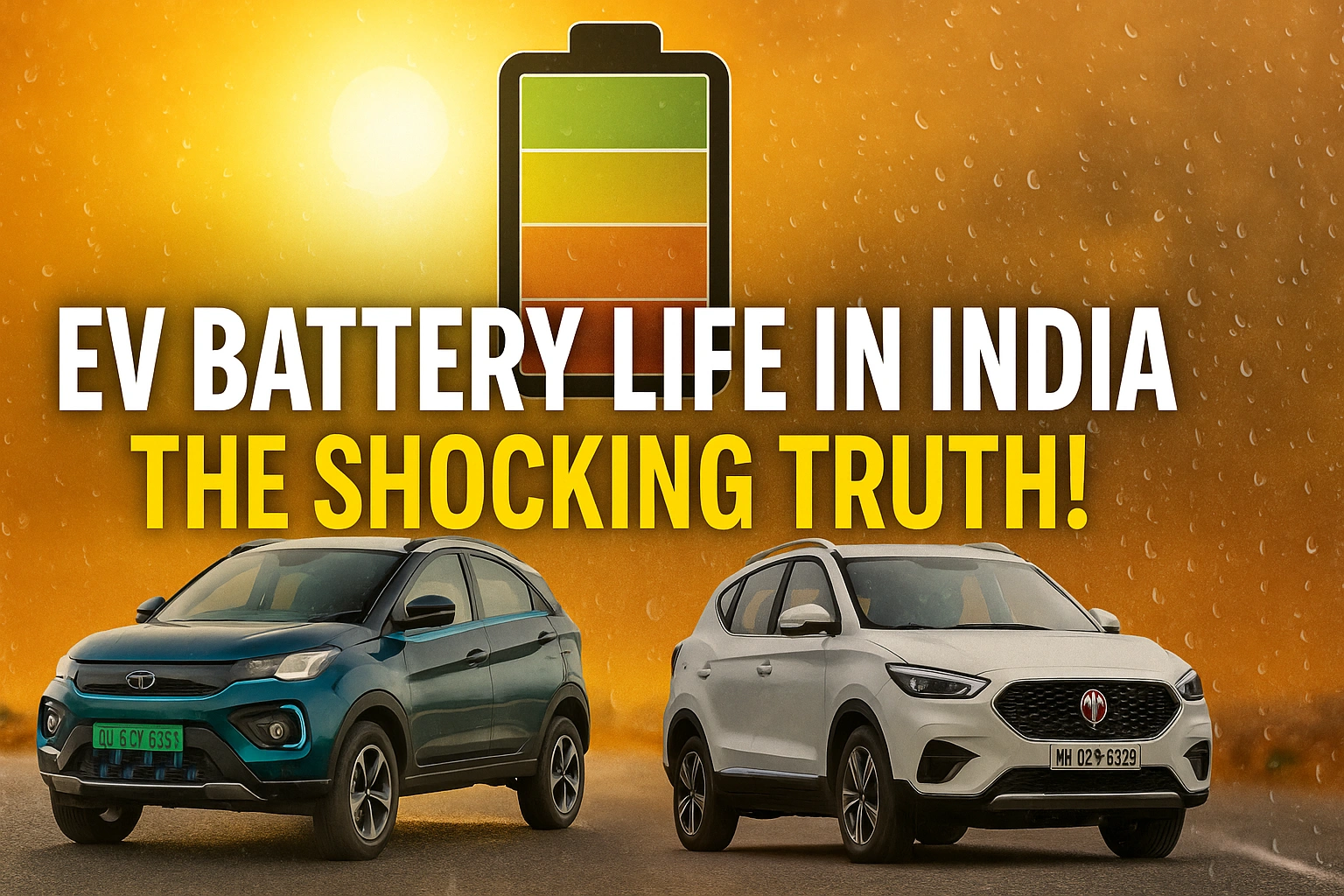
Electric Vehicles (EVs) are no longer futuristic dreams — they are now mainstream in India. From the Tata Nexon EV to the MG ZS EV, more middle-class families are considering EVs as their daily drivers.
But the biggest fear buyers have is: “What happens to the battery after a few years?”
Since the battery is the heart of an EV, its health decides not only mileage but also long-term ownership cost.
Let’s break down how Indian climate impacts EV batteries, how much they degrade after years of use, and what it means for middle-class families planning to buy one.
🔋 How EV Batteries Work (In Simple Terms)
- Most EVs in India use Lithium-ion batteries.
- Each battery has hundreds of small cells, just like your mobile phone battery but on a larger scale.
- Over time, with charging cycles (charge + discharge), battery capacity reduces.
- Average EV battery life: 8–10 years or 1.5–2 lakh km (with ~20% loss).
👉 Manufacturers offer 8-year warranties, but that doesn’t mean “no degradation” — it just means if your battery fails completely, you’re covered. Normal wear and tear is expected.
🌡️ Indian Climate & Its Impact on EV Batteries
Unlike Europe or Japan, India has extreme weather conditions that accelerate battery wear:
- Hot Summers (Delhi, Chennai, Nagpur, Hyderabad)
- Heat is the biggest enemy of lithium batteries.
- Cells degrade faster at 40–45°C.
- Owners report faster range drop in peak summers.
- Humid Climate (Mumbai, Kolkata, Kochi)
- Moisture increases chances of corrosion inside battery packs.
- Manufacturers seal batteries, but humidity still causes minor wear.
- Cold Weather (Shimla, Leh, Manali)
- Batteries perform better in terms of degradation (slower wear).
- But range drops temporarily in winter as the battery struggles in cold.
📌 Conclusion: In India, heat + humidity make batteries lose efficiency faster compared to countries with mild climates.
📊 Real-World EV Battery Degradation Data
1. Tata Nexon EV (Most Popular in India)
- Claimed Range: 312 km (old), 465 km (new MAX)
- Real Owner Data (after 3 years / ~50,000 km):
- Average drop: 8–10% capacity loss
- Range reduces to ~260–280 km (old version).
2. MG ZS EV
- Claimed Range: 461 km
- Owner Data (after 3 years / 40,000 km):
- Capacity drop: 7–9%
- Range reduces to ~400–420 km.
3. Hyundai Kona EV
- Claimed Range: 452 km
- Real-world reports (50,000 km, 4 years):
- Drop: 6–8%
- Range ~410 km.
4. BYD Atto 3
- Too new in India, but global data shows 3–4% loss per year.
👉 Compared to petrol engines (where mileage drops only slightly), EVs show noticeable range reduction with age.
💰 Battery Replacement Cost in India (2025 Estimates)
This is the biggest hidden worry for middle-class families:
- Tata Nexon EV → ₹5–6 lakh
- MG ZS EV → ₹6.5–7 lakh
- Hyundai Kona EV → ₹7–8 lakh
- BYD Atto 3 → ₹8–9 lakh
- Tata Tiago EV → ₹3.5–4 lakh
⚠️ Most warranties cover manufacturing defects only, not natural degradation.
So if your Nexon EV battery drops to 70% after 7 years, that’s considered normal.
📉 Cost Comparison: EV vs Petrol Car (7 Years, 80,000 km)
Let’s calculate for a middle-class family driving ~12,000 km/year.
🚗 Case A: Tata Nexon EV (New MAX Version)
- On-road price: ₹18 lakh
- Running cost: ~₹1/km (electricity @ ₹7/unit, 7 km per unit)
- Total in 80,000 km: ₹80,000
- Battery replacement risk after 7–8 years: ₹5–6 lakh
🚗 Case B: Hyundai Venue Petrol
- On-road price: ₹13 lakh
- Mileage: 14 kmpl
- Fuel cost @ ₹100/litre = ~₹7/km
- Total in 80,000 km: ₹5.6 lakh
👉 Savings in fuel (EV) = ₹5.6 lakh – ₹80,000 = ₹4.8 lakh
👉 But battery replacement (₹5–6 lakh) cancels this benefit if required.
📌 Bottom Line: EVs make sense if:
- You drive 15,000+ km/year (higher savings).
- You keep the car for 7–8 years max (before battery replacement needed).
⚡ Tips to Slow Down Battery Degradation
- Charge between 20–80% → Avoid full 100% charging daily.
- Use Fast Charging Occasionally → Too much DC charging heats battery.
- Park in Shade → Protects battery from heat damage.
- Update Software → Manufacturers release battery optimization updates.
- Drive Smoothly → Aggressive acceleration = higher battery stress.
✅ Conclusion
EV batteries do degrade, but in India’s climate, expect around 7–10% loss every 3 years. That means after 8 years, most cars will have ~80% of their original range left.
For middle-class families, this means:
- EVs are cheaper to run daily than petrol cars.
- But factor in the battery replacement risk after 7–8 years.
- If you drive a lot (15,000+ km/year), EVs are worth it. Otherwise, hybrids or petrol cars may make more sense.


